
Last week, I introduced you to my monthly baking challenge. It’s a project I’d been brainstorming for awhile, but never got around to actually executing. Now that it’s live, I wish we had all been doing this together sooner!
February’s baking challenge recipe revolves around chocolate. Molten chocolate lava cakes, if we’re being particular! And as Valentine’s Day approaches, I figure this week is the perfect time to discuss the delicious beast that is chocolate. Grab a cup of coffee and stick around because this is a good one.
Welcome to another baking basics!
When I was in St. Lucia last year, we took a half-day tour and learned about all about its agriculture. Most specifically, cacao. Obviously my favorite part of the day. Let’s see how much I can remember!
Chocolate is derived from cacao—and it doesn’t become chocolate until the pod is harvested, the beans are removed from the pod, then fermented, dried, roasted, ground into a paste (aka chocolate liquor—no alcohol!), then mixed with other ingredients like sugar and milk (milk chocolate!). Woo-eee! That’s a lot.
After that roasting, however, the shells are removed from the dried cacao beans which leaves the cocoa nib. The nib is what you need for chocolate! Well not YOU but the chocolate makers. These nibs are what are ground into chocolate liquor. Chocolate liquor can be sold as such, also known as “baking chocolate” (more on baking chocolate below!) or processed further to separate the fat (cocoa butter) and eventually become cocoa powder.
Bars, Chips, Powder?
The baking aisle is loaded with chocolate choices. Who knew such a tasty aisle could leave us in so much bewilderment? Let’s start with cocoa powder. Actually, let’s rule it out completely. Cocoa powder, while from cacao as you know, is a completely different ingredient. If you’re interested in more about this very particular ingredient, I recommend this post on Dutch-process vs. natural cocoa powder.
When a recipe calls for chocolate (not “cocoa” and not “chocolate chips”) the recipe is referring to baking chocolate. It’s not referring to chocolate chips. Thanks to stabilizers and preservatives, chocolate chips are designed not to melt under heat. If you stick them in the microwave or double boiler, you’ll certainly have a melted chocolate product. Delicious, of course, but not what you want as the base of your brownies, cakes, in puddings, ganache, frosting, lava cakes, or coating around your candies. Save the chips for your chocolate chip cookies; they taste best that way!
Baking chocolate, on the other hand, is what you should be reaching for. In its pure form, baking chocolate is unsweetened chocolate aka chocolate liquor. It is 100% chocolate without any added sugar or flavors. It’s bitter and therefore used in recipes with added sugar. While “baking chocolate” is unsweetened chocolate, you can use other chocolate varieties in baking. It’s a little confusing, I know. Chocolate used for baking can also be bittersweet, semi-sweet, milk, and white chocolate varieties—but the term “baking chocolate” typically means unsweetened. Got it?
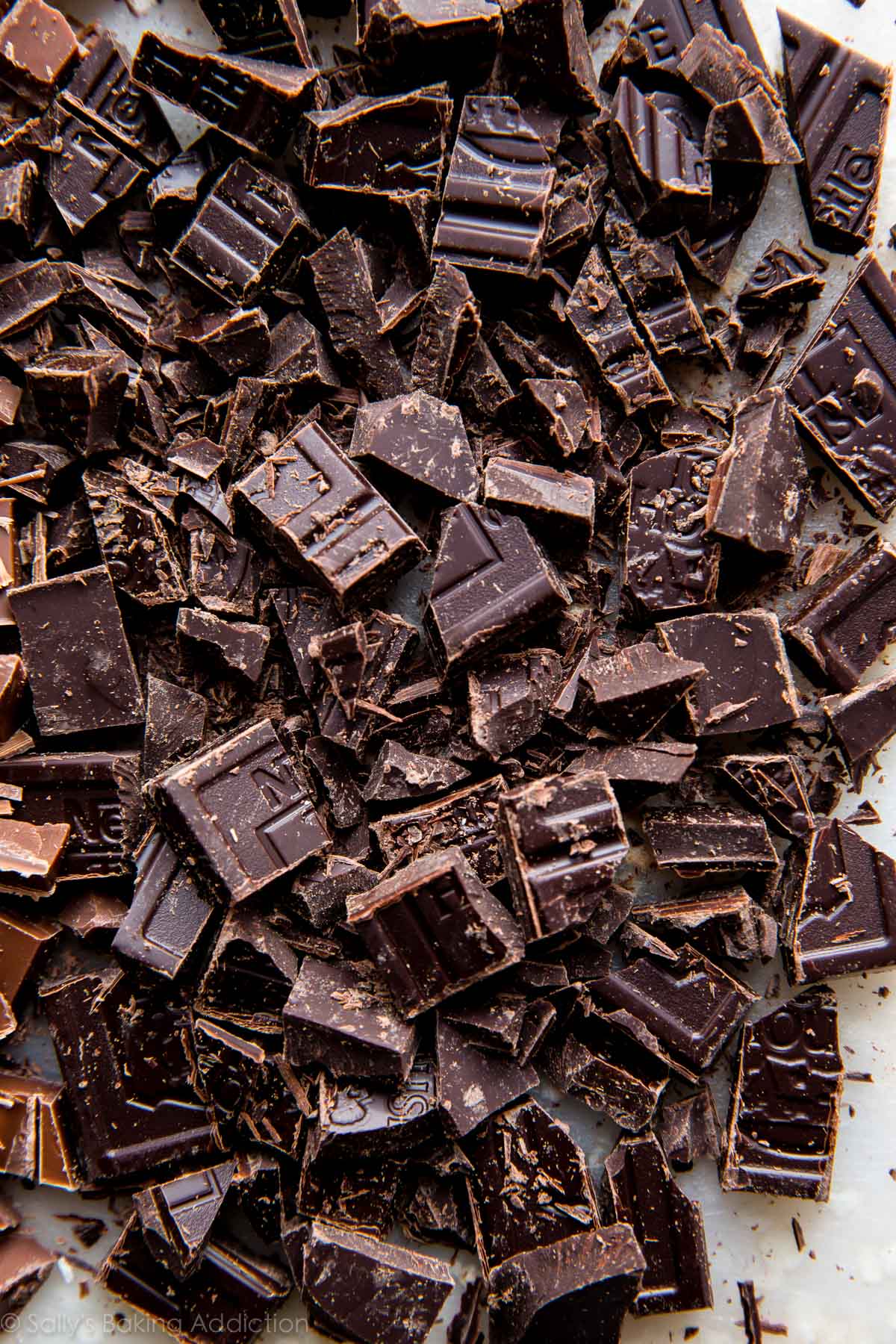
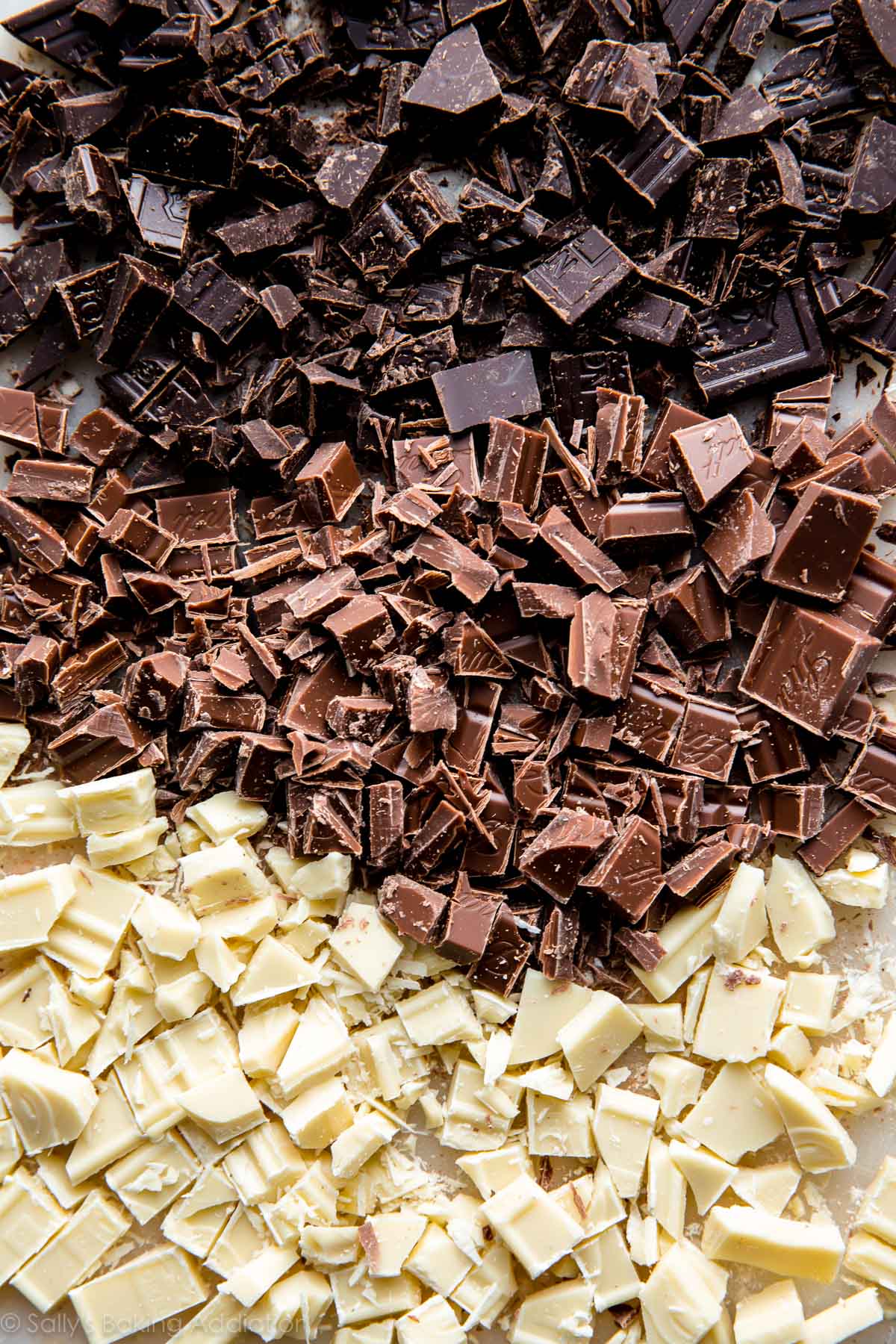
Major chocolate brands in the baking aisle sell chocolate in bar form, typically 4 ounce bars—and they’re right next to or above the chocolate chips in the baking aisle. There are several brands to choose from like Baker’s, Ghirardelli, Lindt (Lindt bars are actually sometimes in the candy aisle), Nestle, Scharffen Berger, etc. The latter is a pricier choice but you get what you pay for: absolutely DIVINE chocolate. If you shop at Trader Joe’s, their “Pound Plus” bar is the right choice. Great quality and hefty amount for a steal of a price!
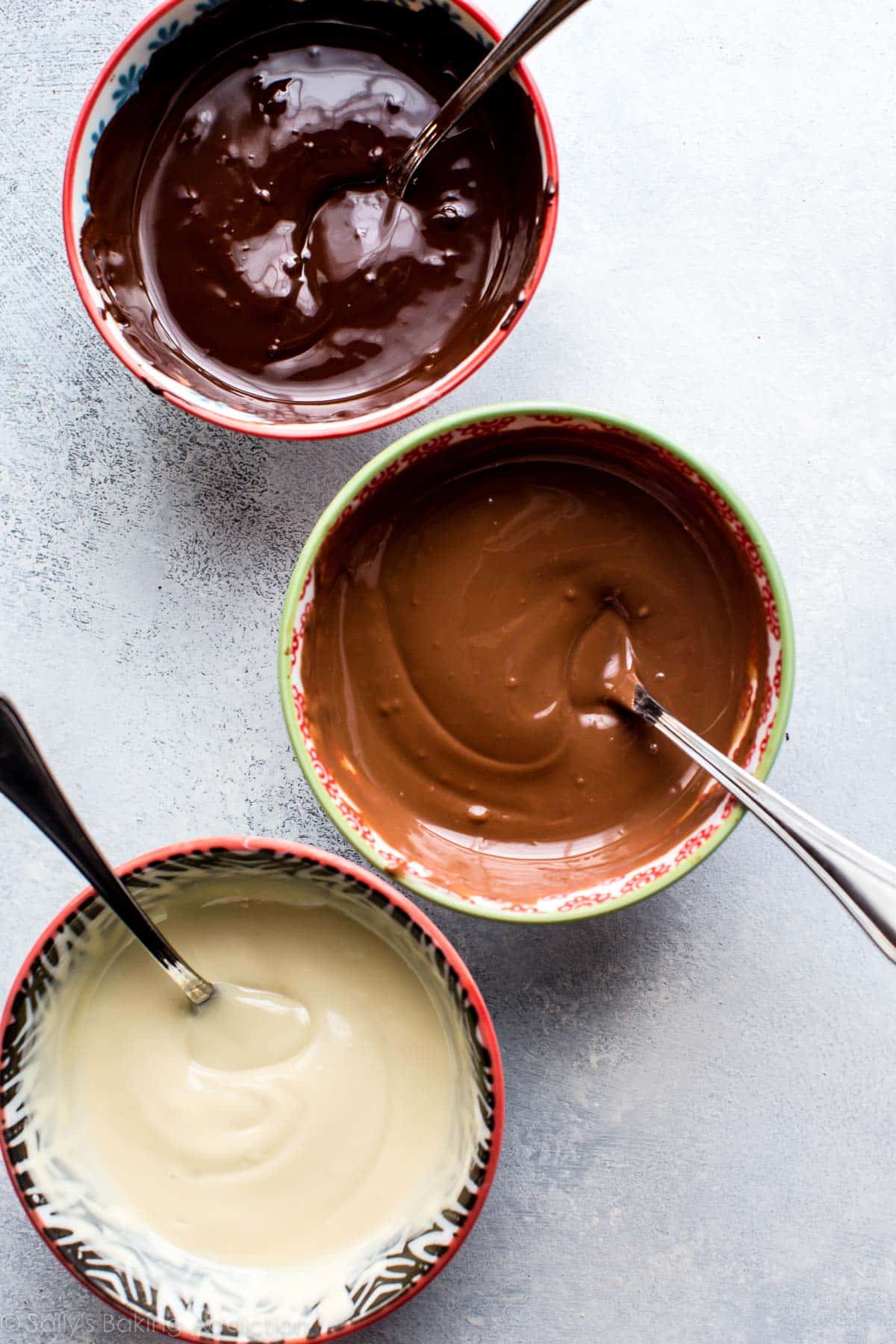
This chocolate melts down uniformly because it contains few additional ingredients besides the cacao. If I’m using chocolate as a coating for candies, sometimes I add 1/2 teaspoon of oil when I’m melting it down. This makes dunking and dipping easier because it slightly thins out the chocolate.
Did you know? All baking chocolate—whether that is unsweetened, bittersweet, semi-sweet, etc—is tempered in factories before you buy it. Tempering is a matter of heating and cooling melted chocolate to certain temperatures so that the finished chocolate will have a glossy surface, a smooth texture, and snap when you break it. Properly tempered chocolate will not melt on contact with your fingers. But once you melt it down to use as coating for candies and such, the tempering process must be repeated in order to maintain the same desirable texture. I discuss tempering chocolate at length in Sally’s Candy Addiction if you have a copy. Though never required for my recipes (melting without tempering is OK!), we only need to worry about tempering chocolate when using it for candy. Turn to page 42 to learn more!
What are Chocolate Wafers?
Grocery stores also carry chocolate wafers. They’re perfect for melting as a coating because they don’t contain stabilizers. Wafers are fantastic for unbaked goodies like chocolate ganache, puddings, frostings, and coating around candies. Unlike baking chocolate, I don’t recommend wafers for actual baked recipes. You want to reach for chocolate that is made for baking.
Percentages on Chocolate
Ever wonder what the percentage on a chocolate bar means? This number actually tells you quite a lot about the flavor you’re about to unwrap—it refers to the percentage of ingredients by weight coming from cacao. A higher percentage means more intense chocolate flavor and less sweet.
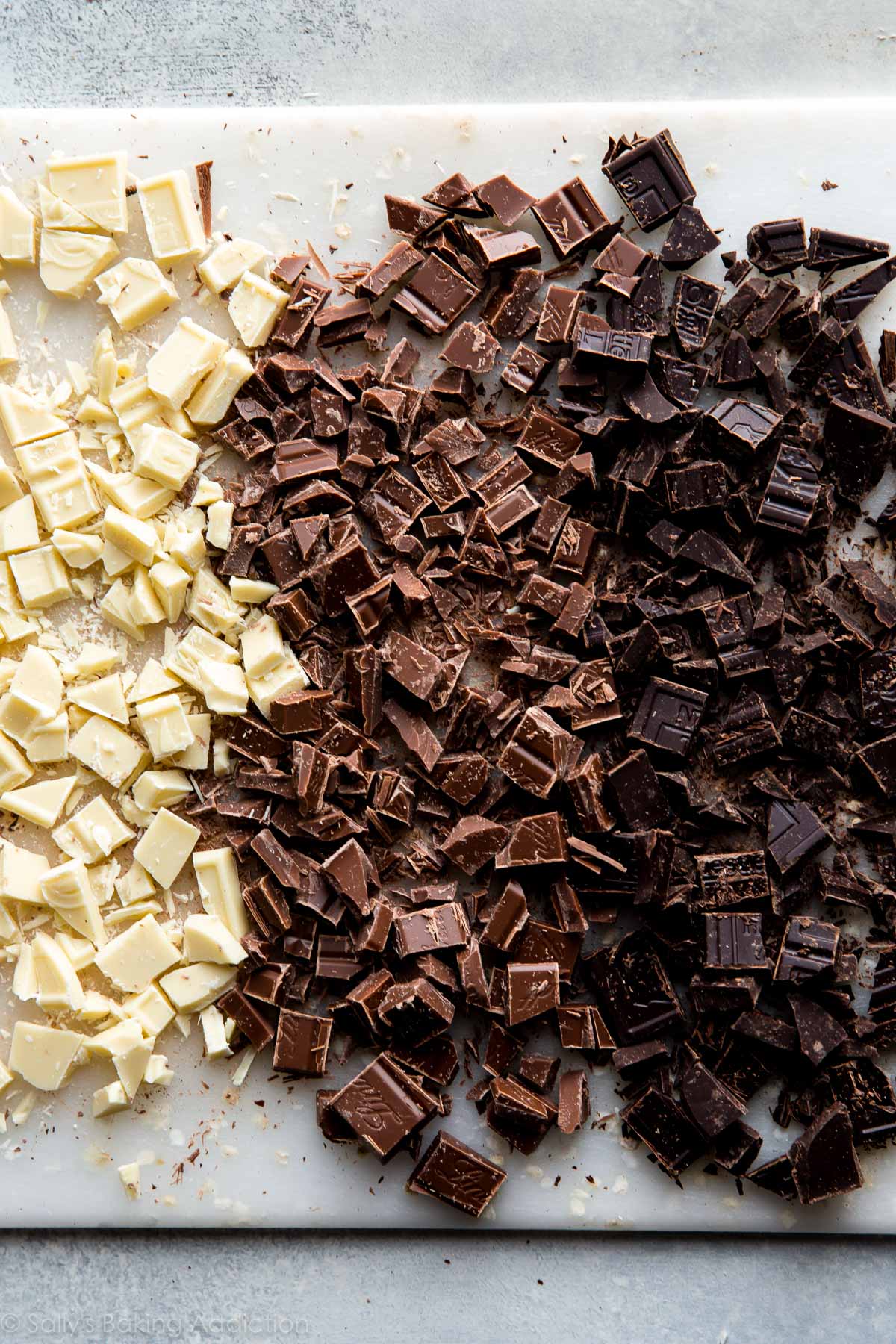
Types of Chocolate
White chocolate: let’s start here because it’s not technically chocolate! White chocolate has cocoa butter in it, but does not contain any chocolate liquor. Remember learning about those two above? Since there’s no chocolate liquor, many argue that white chocolate isn’t technically chocolate. Whatever, it’s still amazing.
Bittersweet/dark chocolate: these two terms are usually used interchangeably. “Semi-sweet” contains 35 – 45% cacao and is usually sweeter than bittersweet or dark varieties. However, there are no legal restrictions to distinguish between all 3 and, depending on the brand, “bittersweet” or “dark” may have the same percentage as “semi-sweet.” Regardless, it will be darker and more intense than milk chocolate and sweeter than unsweetened.
Semi-sweet: see above. It can be used interchangeably with bittersweet/dark chocolate. It’s what I use most often in baking because it’s the most readily available. It’s the base of our lava cakes!
Milk chocolate: only 10% cacao. Super sweet and oh-so-good!
Q: What’s your favorite?
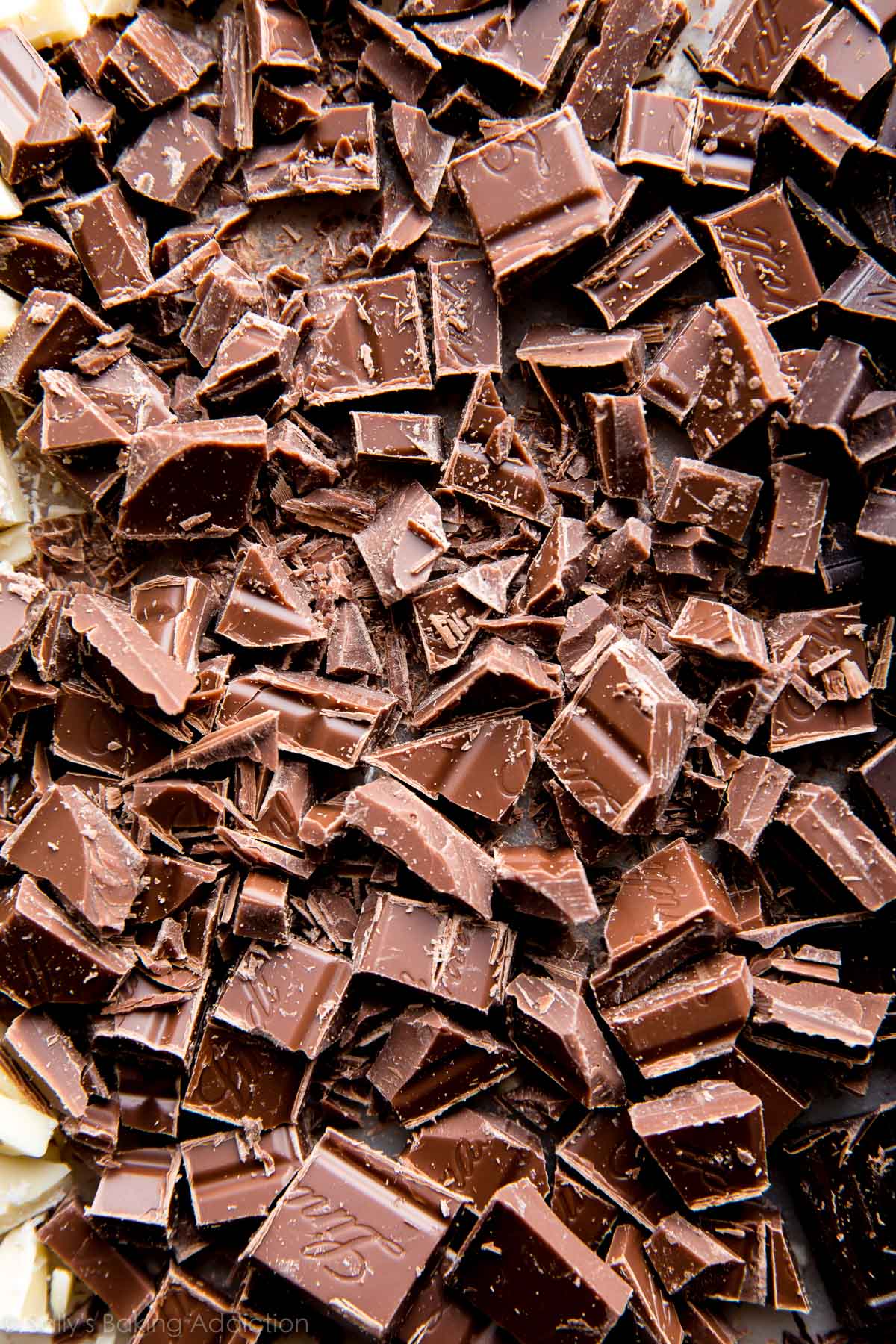
I’ll have to write a separate post on melting and tempering chocolate sometime!
More baking lessons & tips:
- Why Room Temperature Ingredients Make a Difference
- My 10 Best Baking Tips
- 14 Best Baking Tools That Every Baker Needs
- Favorite Candy Making Tools
- Dutch-process & Natural Cocoa Powder
- Salted Butter vs Unsalted Butter in Baking
- How to Fill Cupcakes








Reader Comments and Reviews
Can I use cacao in place of natural cocoa in your chocolate cupcakes recipe??
Hi Meghann, Cacao is more bitter, we would recommend sticking to cocoa powder if that’s what a recipe calls for.
FYI, Consumer reports published a report last year showing amounts of lead and cadmium in various dark chocolates. Lindt, Hersey’s, Scharfenberger, Godiva had some of highest levels.
https://www.consumerreports.org/health/food-safety/lead-and-cadmium-in-dark-chocolate-a8480295550/
I have finally found a recipe everyone wants me to make, but my problem is covering the chocolate balls with melted chocolate. I can never get the melted chocolate even around the whole cookie or it becomes so thick then the chocolate wafers, while covering the cookie, is gone before I even get started. I’m wasting so much money on the chocolate coating because I can’t get it right. Please tell me the easiest method to cover these round cookies in chocolate. The look awful but taste great. I’ve tried the spoon technique, the pour over technique and besides the mess, I want to get good at this.
Hi Terry! Are you referring to coating balls (like these Oreo balls) or round cookies (like these thin mints)? We always recommend using pure baking chocolate, thinned with a small amount of oil. There’s lots of tips and tricks in both those posts for coating!
Will your “Sally’s Candy Addiction” be available anytime soon? Thank you.
Hi Diane, Unfortunately there won’t be any new re-prints of that book. But it is still available on Kindle.
Hi Sally, I made your Swiss Rolls for my daughter in law’s covid birthday “cupcakes”. My son was so impressed that he asked me to make a carrot cake rolls for his birthday. Will white Bakers chocolate work to make the ganache?
Hi Nicki! Yes, you can make chocolate ganache with white chocolate – see our post on chocolate ganache for details! There’s instructions for using white chocolate in the recipe notes. Enjoy!
What chocolate do you suggest for Silk chocolate pie? I have a request for this for a birthday!
Hi Linda, We use two 4-ounce quality semi-sweet chocolate bars for our French Silk Pie.
HI, love this blog. I have several chocolate bars lindt 90% that I want to make into milk chocolate bars (less intense). How do I do that please?
Hi Sally, this is am amazing post. Looks like I am addicted to your blog!.
I love the way you write and explain simple yet significant things that are key to baking well. I would like to know, if Chocolate Compound can be substituted for Baking Chocolate. If yes, in what kind of recipes. Would love to hear from you on this if your time permits. Thank you so much and appreciate all that you share here with all of us.
Regards..
Thank you so much for your kindness! I’m glad to help. Compound chocolate would be fine in most recipes calling for pure baking chocolate, especially if used as a coating or for dipping.
Which baking chocolate or chocolate wafers do you prefer to use?
Hi Aaliyah! I really like Bakers or Ghirardelli brand baking chocolates. They’re sold in the baking aisle by the chocolate chips.
Hi Sally,
Would LOVE to read about tempering
Sally – I love, love, LOVE reading this type of posts. Of course, your recipes are fabulous but so are these. I used to work for a ‘chocolatetier’ where I learned that chocolate that was not kept at the proper temperature (too hot or too cold) blooms or turns whitish. It is still good to eat or even use, but it looks unsightly so products could not be sold that had bloomed. Not to nerd out any more – just a handy tidbit that has stuck with me over the years. 🙂
I LOVE your baking basics series; the science is fascinating to me. Keep them coming!!
Thanks, Sally, for the great information! My favorite is dark chocolate!
Thanks for this post. I learned so much!